

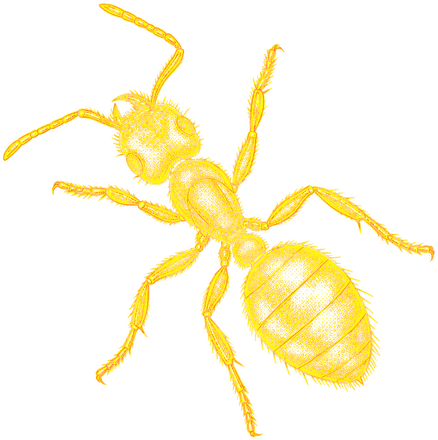
Ants
A trail on the counter, winged ants at the window in spring, carpenter ants working damp wood. The trail is the symptom — the nest is the job.
Overview
An ant trail on the counter is not a random visitor. It is a foraging route running between an established nest and something worth carrying home, which means there is a colony somewhere — under the front slab, out in the yard, behind the trim, or inside a damp section of framing.
That is the whole reason ant control has to reach the colony instead of the trail. Ants are social insects, and the workers you can see are a small share of the population. Killing the ones on the counter changes nothing; the nest replaces them inside a few days.
Two species account for most Manitoba calls. Pavement ants nest under walkways, driveways and slabs and come indoors after grease and sweets. Carpenter ants hollow out damp or already-damaged wood to nest in it — they do not feed on wood — and they are the ones worth taking seriously, because finding them indoors usually means water is getting into the structure somewhere.
How to identify
- Pavement ants are small, roughly 3 mm and dark brown, and nest under walkways, driveways and slabs.
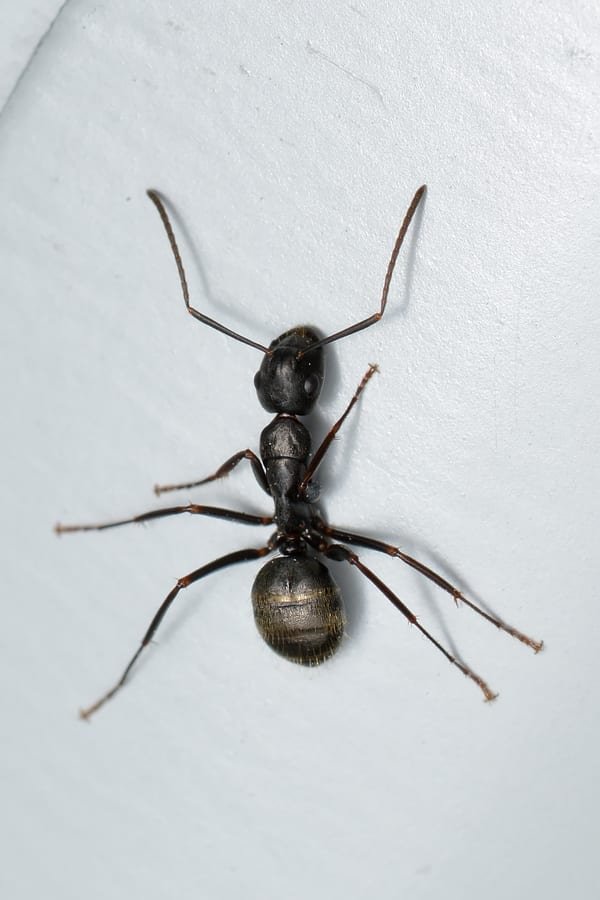
- Carpenter ants are large, 6–13 mm, black or black-and-red, and are most active after dark.
- Carpenter ants excavate smooth galleries in damp or previously damaged wood to live in. They do not eat the wood, they push the shavings out.
- Winged ants indoors in spring are reproductives from a mature colony, which usually places the nest in or hard against the building.
- Ants have elbowed antennae and a pinched waist, which is the quickest way to separate them from the other small dark insects that turn up on a windowsill.
Fast facts
- Most common
- Pavement ant and carpenter ant
- Peak season
- Spring through late summer
- A trail indoors means
- A nest with a route to your food
- Key step
- Treat the colony, not the trail
Signs to watch for
- A steady trail along a counter edge, a baseboard or the line where the floor meets the wall.
- Ants appearing at the same spot day after day, usually near a sink, dishwasher, pet bowl or garbage.
- Fine sawdust-like shavings mixed with insect parts under trim, window frames or sill plates — that is carpenter ant frass.
- A faint rustling inside a wall or window frame at night where a carpenter ant colony has some size to it.
- Winged ants at a sunny window in spring.
Why it matters
- Ants across prep surfaces and into stored food are a sanitation problem at home and a much bigger one in a restaurant or commercial kitchen.
- Carpenter ants weaken damp or already-damaged wood over time, and their presence is a signal there is a moisture problem to fix alongside the ants.
- Retail sprays routinely make ant problems worse: a repellent product splits the colony, satellite nests bud off into new spots, and one trail becomes three.
- A nest left alone sends foragers back along the same route season after season.
How we handle it
Our approach
Identify the species
We confirm which ant you have and follow the trail back toward the nest, indoors and outdoors. Why it matters: a pavement ant nesting under the front step and a carpenter ant nesting in a wet sill plate are two different jobs with two different fixes, and guessing wastes a visit.
Find the nest and the moisture behind it
With carpenter ants we look for the damp wood that made the site attractive in the first place — a leaking window, a failed seal, a roof or plumbing leak, wood sitting against soil. Why it matters: treat the ants and leave the water, and another colony moves into the same spot.
Treat the colony, not the trail
We use non-repellent products and baits that foraging workers carry back and share through the nest, and we treat nest sites directly where we can reach them. Why it matters: product that travels home reaches the brood and the queen. A wiped-out trail reaches four ants.
Perimeter and entry-point work
We treat the exterior perimeter, the foundation line and the routes ants are using to get in. Why it matters: most ants found indoors are nesting outside, so the perimeter is where the traffic actually gets stopped.
Follow-up
We come back to check the trails and the bait and adjust if the colony has shifted. Why it matters: colony control takes time to work through a nest, and the follow-up visit is what confirms it did rather than assuming it did.
Prevention
Keep them from coming back
- Wipe up spills and crumbs, and keep sweet and greasy residue off counters, floors and the front of cupboards.
- Store sugar, syrup, pet food and open packages in sealed containers.
- Fix leaks and keep sills, trim and framing dry — damp wood is what invites carpenter ants.
- Keep mulch, soil and firewood back from the siding, and trim branches that touch the roof or walls.
- Seal gaps at door sweeps, thresholds, utility penetrations and window frames.
- Leave the retail spray in the cupboard when you find a trail. It scatters colonies more often than it solves them.
Questions
Ants questions, answered
I sprayed the trail and now there are ants in two other rooms. What happened?
That is the classic result of a repellent store-bought spray. The ants avoid the treated area, and the colony responds by budding — splitting off satellite nests into new spots. Professional work goes the other way, using non-repellent products and baits that workers carry back into the nest, so the colony gets treated as one unit instead of being scattered.
Do carpenter ants eat wood?
No. They chew galleries into wood to nest in and push the shavings back out, which is why you find frass on the floor before you find any damage. They go for damp or already-damaged wood, so carpenter ants indoors are usually telling you there is water getting in somewhere that needs attention.
How long before the ants stop?
Bait has to move through the colony, so activity often looks the same or slightly busier for a few days before it drops away. Most homes see trails fade over one to three weeks. We give you an honest read once we know the species and where the nest is.
There are winged ants at my window in spring. Is that a swarm?
Those are reproductives leaving a mature colony. Finding them indoors usually means the nest is in or right against the building rather than out in the yard, so it is worth an inspection rather than a vacuum and a shrug.
Get it handled
PESTS DON'T WAIT. NEITHER SHOULD YOU.
Call Central Prairie Pest Control or send the quote form — you'll get a clear price and plan before any work starts.